title: "The only grocery budget guide you'll ever need" description: "How to set a weekly number, actually stick to it, and save $100+ a month without giving up the food you love." publishedAt: "2024-12-05" author: "Suprabha" category: "budget" tags: ["savings", "planning", "family"]
Most "how to save on groceries" articles give you tips. Clip coupons. Buy store brand. Shop the perimeter.
They're not wrong. They're just not a system.
Here's the actual system we use. Takes 15 minutes to set up, and we save roughly $100 a month without it feeling like deprivation.
Step 1: Find your real number
Before you set a budget, find your actual current spending. Most people are shocked.
Pull up the last 3 months of grocery transactions. Add them up. Divide by 12 to get a weekly average.
For us, that number was $287/week. We would've guessed $200.
That gap — between what you think you spend and what you actually spend — is where savings live.
Step 2: Set a number that's 15% lower
Don't try to cut your budget in half. You'll fail by Wednesday.
Take your real number and cut it by 10–15%. For us, $287 became $250. Ambitious but not insane.
This matters: a budget you stick to 90% of the time beats a budget you abandon in two weeks.
Step 3: Know what fills your cart
This is the step everyone skips. Pull up one grocery receipt. Categorize every line:
- Protein (meat, fish, eggs, tofu)
- Produce (fruits, vegetables)
- Dairy (milk, cheese, yogurt)
- Pantry (rice, pasta, canned goods, oils)
- Beverages
- Snacks & treats
- Household (paper towels, soap — not groceries!)
For a typical household, the breakdown looks something like:
- Protein: 30–35% of groceries
- Produce: 20–25%
- Dairy: 10–15%
- Pantry: 15–20%
- Everything else: 10–15%
If any category is way off that ratio, you've found your leak. Ours was "beverages." We were spending $40/week on sparkling water and fancy juice.
Step 4: Plan the expensive stuff first
Protein is the biggest line item in most households. It's also where the biggest waste happens.
Plan your proteins first:
- Two nights with chicken (buy family pack, portion, freeze)
- One fish night (salmon or frozen shrimp)
- One vegetarian night (beans, lentils, eggs — cheap!)
- One "use leftovers" night
- One "fend for yourself" night
- Weekend flex
Suddenly you've planned 85% of your cart with one decision.
Step 5: Give yourself permission to overspend on 3 things
Nobody sticks to a budget that feels punishing. So we deliberately don't budget three things:
- Good coffee (we love it)
- Fresh flowers once a month
- One "fancy" dinner ingredient per week
Everything else is optimized. Those three things feel like luxuries. That's enough.
What it's worth
Six months of this:
- Grocery spending: $287/week → $228/week average
- Food waste: down ~60% (that's the real multiplier)
- Takeout: down ~$180/month, because we actually cook the food we buy
- Stress about money: noticeably lower
Total savings: ~$400/month, conservatively.
The 30-second version
- Find your real number
- Cut it by 10–15%
- Know your category breakdown
- Plan proteins first
- Permission to overspend on 3 things
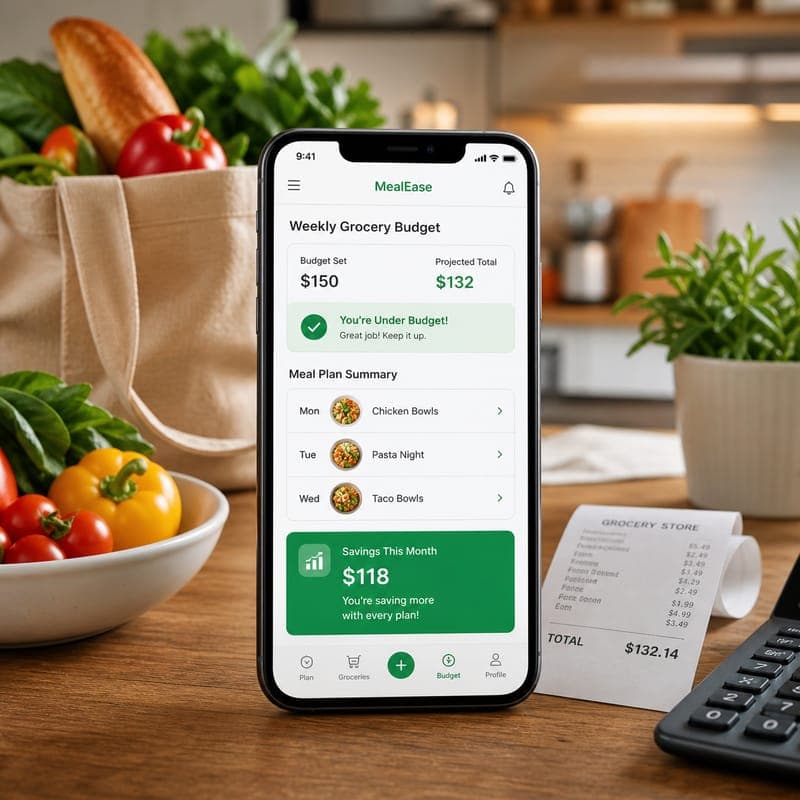
That's it. No coupons, no apps required (though MealEase does all this automatically if you'd rather not think about it).
The money was never the hard part. The thinking was the hard part. Once the thinking is solved, the money solves itself.
— Suprabha
Dinner without the nightly reset
Turn tonight’s idea into a plan.
Plan dinners with the grocery total in view.
About the author
Suprabha is a MealEase co-founder, CPA, and parent who writes about the practical side of feeding a busy household.
How we created this guide
This guide was written from MealEase product workflows, common household meal planning patterns, and the practical questions families ask around budget.
Downloadable planning tools
Get the next one in your inbox.
One email a week, never more. Cancel anytime.